
BEMI 2027
Free Day Camp Program for Young String Players!
May 25 - May 30
Registration is not yet open for BEMI 2027.
Questions? Email SarahECranor@gmail.com for information!

Bloomington Early Music Immersion
BEMI is back and we can’t wait! Join us for our fifth year of collaboration between Bloomington Early Music and the IU Jacobs School’s Historical Performance Institute! As a BEMI Player, you will work on early music performance technique on your instrument with expert instructors from the theHPI, exploring different ways baroque musicians played the music of their time and what has changed in the way this music is played today. And you will perform in a BEMI Players concert at the Bloomington Early Music Festival, a thirty-year tradition that has brought national and international musicians to our community. And BEMI is free for all who participate!
Rehearsals: Tuesday through Friday, May 25 - 28, 9am-3pm | Jacobs School of Music, Indiana University
Dress rehearsal: Saturday, May 29 | Time and location TBD
Concert: Saturday, May 29 | Time and location TBD
Ice cream social: Sunday, May 30, 1-3:30pm | Probably at Bryan Park but check back for details!
BEMI will be held the week of the Bloomington Early Music Festival, Tuesday, May 25th to Sunday, May 31st at the Jacobs School of Music on the IU campus. Daily sessions are from 9am to 3pm, when you will practice new skills, rehearse in baroque orchestra and small ensembles, and hear from scholars and performers of early music about what it was like to live and make music hundreds of years ago.
The BEMI Players will present their week’s work at the Bloomington Early Music Festival on Saturday, May 29th at the 5th Annual Stanley Ritchie Youth Performance, named for the founder of the Bloomington Early Music Festival who was a world-renowed baroque violin pedagogue and performer and a great supporter of BEMI. And on Sunday, May 30th, we will all get together for an ice cream party to celebrate you, your performance, and the great music you have made at BEMI!
BEMI is tuition-free for all participants, thanks to the support of our community and especially the Bloomington Arts Commission of the City of Bloomington. The program is open to current 6th -9th grade string players who have been playing their instrument for at least one year. BEMI Apprentices are for players who have completed BEMI and are in the 10th - 12th grade, or players with a high level of experience in early performance practice. And did we mention the great free BEMI t-shirts??
We are all very excited about this fifth year of BEMI—which will be the best year yet—and we can’t wait to make music together!
more about Bloomington Early Music Immersion
The information below is from the 2026 edition. Please check back in the spring for updates!
-
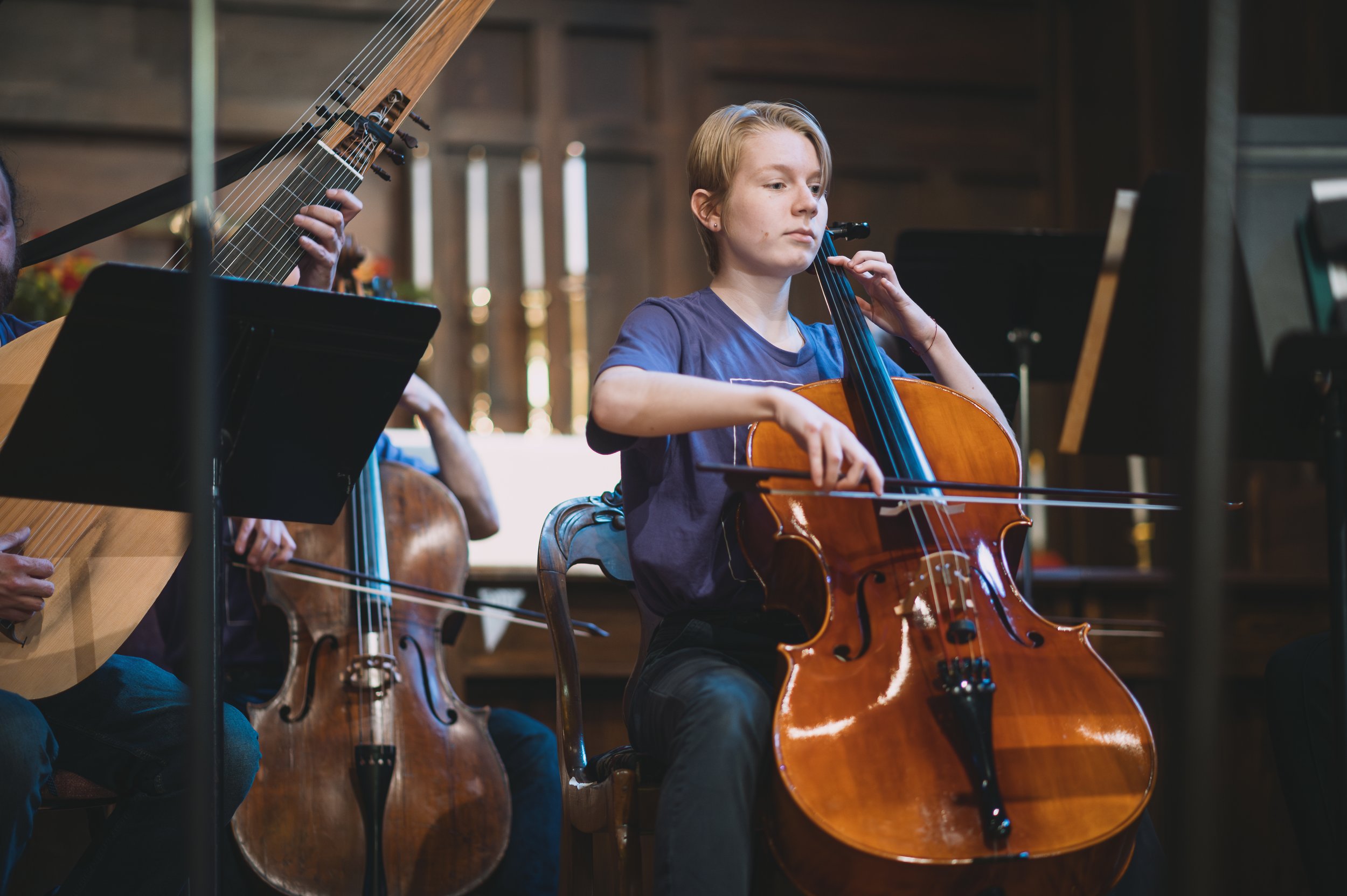
Bloomington Early Music (BLEM) , the Historical Performance Institute (HPI), and now also the Historical Performance Academy (HPA) at Indiana University have joined together for this free day camp experience for young musicians. Bloomington Early Music Immersion (BEMI) offers a first experience in early music performance for middle-school aged string players from Bloomington and surrounding communities, providing them supportive, expert instruction from professional-level players and experienced music educators at the world-renowned HPI. From Tuesday, May 26th to Saturday, May 30th, BEMI Players will explore music from the seventeenth and eighteenth century, meeting daily from 9:00-3:00 for baroque orchestra, small ensembles, individual coaching, and conversations with early music experts. A BEMI Players concert at the Bloomington Early Music Festival will cap off the workshop, with an ice cream celebration with families and instructors the following day. Free BEMI t-shirts and healthy, yummy snacks will also be provided.
-
For students to be able to enjoy and learn during BEMI, the following skills are necessary-
Be comfortable playing:
in the keys of D Major, G Major, C Major, E minor, and G minor
in first and third position (violins and violas)
in first and second position (cellos)
with multiple note slurs
in compound and simple time signatures (such as 6/8 and 4/4)
-
Music will be distributed in early May and must be learned and ready for the first rehearsal on Tuesday, May 26th. Workshop instruction focuses on period style and technique, so these young musicians can go far beyond just learning the notes. Repertoire selection will be selected by BEMI Director Sarah Cranor and advised by the Director of the HPI and BLEM ex-officio board member, Dana Marsh, in collaboration with the instructors.
Parental permission is required for participation. A permission form will be distributed for signature.
BEMI will give young musicians an understanding of how performance changes over time, connect them to the historical context of the music, and show them that learning history can be an embodied experience through performance. The opportunity to learn from experts and perform alongside professionals will show them that they can strive for greatness in whatever they do--they belong with the best!
-
Violinist Sarah Cranor is passionate about sharing historical and contemporary music with live audiences. Sarah directs Tonos, championing works by lesser-known, indigenous, and anonymous composers from baroque-era Latin America. Sarah performs with Chaski Quartet, bringing diverse repertoire to incarcerated individuals and public communities in Colorado and New Mexico, and she performs regularly with the Indianapolis Baroque Orchestra, Sphere Ensemble, Omaha Symphony, Phoenix Symphony, and Arizona Bach Festival. She has led historically-informed projects with the West Texas Symphony, Sphere Ensemble, and the Omaha Chamber Music Society. A passionate educator, Sarah leads the Bloomington Early Music Immersion for middle schoolers and Growing up Baroque, a bilingual program through the Indianapolis Baroque Orchestra in 2025 and 2026. Sarah was a guest artist in residence at the Academia de Música Antigua de Medellín in Colombia, and has presented lectures at EAFIT in Colombia, the UNAM in Mexico, University of Nebraska at Omaha, and Indiana University. Sarah holds a Doctor of Music from Indiana University in historical performance and modern violin. She runs ultra-marathons (recently finishing her first 100-mile race), and always looks forward to exploring new trails.
-
Chicago-born cellist Dr. Kevin Flynn enjoys an active career as a teacher and performing artist, firmly believing that each informs the other. Flynn is Visiting Assistant Professor at the Michael and Anne Greenwood School of Music at Oklahoma State University, Assistant Principal Cello in the Oklahoma City Philharmonic, Acting Principal Cello in the Oklahoma Baroque Orchestra, and the Sajo and Chiqui Fellow of the International Chamber Orchestra of Puerto Rico. He is cellist in the groundbreaking historically-informed chamber ensemble Tonos del Sur and the prize-winning Cercis String Quartet. Highlights of Flynn’s 2025-26 season include a CD recording, tour, and video production of Vivaldi’s Four Seasons Concerti with Emilio Colón and the Colón Cello Quartet, concerts with the Brightmusic Society of Oklahoma, BEMI & BLEMF2026 with Tonos, and musical collaborations with cellists Sterling Elliot and Sophie Shao. violinist Jeff Myers, pianist Dr. Tomomi Sato, and clarinetist Wendy Bickford
Phoebe Gelzer-Govatos, historical and modern violinist, resides in Ann Arbor, Michigan, and performs with a number of orchestras and chamber ensembles throughout the state, including the Ann Arbor, Lansing, Adrian, and Kalamazoo symphony orchestras. As a historical player, Ms. Gelzer-Govatos is a core member of period instrument ensembles l’Invenzione and Ensemble Affect, and plays frequently with early music groups across the country, as well as coaching high school and college students in historical style and technique. Recent highlights include performances with Early Music Michigan, Tonos, and Audivi. At home in Ann Arbor, Phoebe maintains a private violin and viola studio, teaches chamber music at the Rudolf Steiner High School, and likes to involve herself in creative endeavors of all kinds.
Esteban Hernández Parra, DM (él/he): I am a son, an immigrant, a mestizo, and a doctor musician from Colombia dedicated to building community around learning, playing, and teaching viola. The musical interactions I sustain across Abya Yala (the Americas) are not only political, but also continuously transformed by the work of my mentors, teachers, ancestors, colleagues, family, students, and friends: it is thanks to our communion that we resist in joy; listening and sounding in solidarity. My action as a performer and researcher is rooted in decolonial work. I engage with communities whose musical practices reclaim local identities and ancestral territories in Abya Yala, towards a continuous dignification of our existence. Through teaching at University of Arizona, I learn from+with my students and colleagues as we sustain collaborations through Viola Rola, TucSon Jarocho, La Peña del Surco, TUSD, Arizona ViolAcademy, AZ Phil, Bach Collegium Fort Wayne, Bloomington Early Music Festival, and Tanguí Chirimía.
Danur Kvilhaug is active as a lutenist and vocalist, performing regularly throughout North America. Recent engagements include performances with the Newberry Consort, Les Delices, Bourbon Baroque, Tonos, and the Bloomington Symphony Orchestra. Additionally, he has performed at the Madison Early Music Festival, the Bloomington Early Music Festival, and with the Red River Lyric Opera’s 2019 performance of Francesco Cavalli’s La Calisto. In addition to performing, he has held several teaching appointments, teaching courses in music history and music theory at the Indiana University Jacobs School of Music and The University of Oklahoma. He received his MM in Musicology from The University of Oklahoma, as well as an MM and Performance Diploma in historical performance at Indiana University under the tutelage of Nigel North. He is currently pursuing a doctorate in historical performance practice at Case Western Reserve University under the tutelage of Charles Weaver.
-
Established in 1992 by renowned violin pedagogue Stanley Ritchie and his associates, Bloomington Early Music (BLEM) began as an inspiring community concert series under the name Early Music Associates. Two years later, a group of enterprising students from Indiana University’s Early Music Institute—now the Historical Performance Institute (HPI)—joined this community effort to establish the Bloomington Early Music Festival. Over the next three decades, our organization has brought to south central Indiana some of the world’s most significant performers of music of the medieval period through the early nineteenth century, many of whom themselves have deep artistic roots in this region. BLEM has partnered with national organizations such as Early Music America, sponsors local ensembles and educational outreach, and collaborates with the HPI, the IU Latin American Music Center, and leading music scholars at IU’s Jacobs School of Music. The support of emerging talent and of music that is global and multicultural stands alongside our commitment to societal engagement through music as the most cherished values of our organization. Our mission to enrich, educate, and inspire audiences and performers is most broadly expressed through the annual Bloomington Early Music Festival, a weeklong, free-admission series of concerts, workshops and talks given by internationally esteemed performers and scholars, alongside the many celebrated early musicians of our community.


Bloomington Early Music Immersion aims to inspire young musicians at a critical moment in their development as performers in a supportive, inclusive, and noncompetitive setting for exploration, learning, and social connection through the embodied experience and creative freedom of Historically Informed Performance.


This program has been generously supported by the Bloomington Arts Commission of the City of Bloomington from 2023-2026.

Bloomington Early Music Immersion is a proud recipient of the 2023 Engagement Award from Early Music America.

Bloomington Early Music is grateful to the Smithville Charitable Foundation for their generous support of the BEMI program in 2023 & 2024.